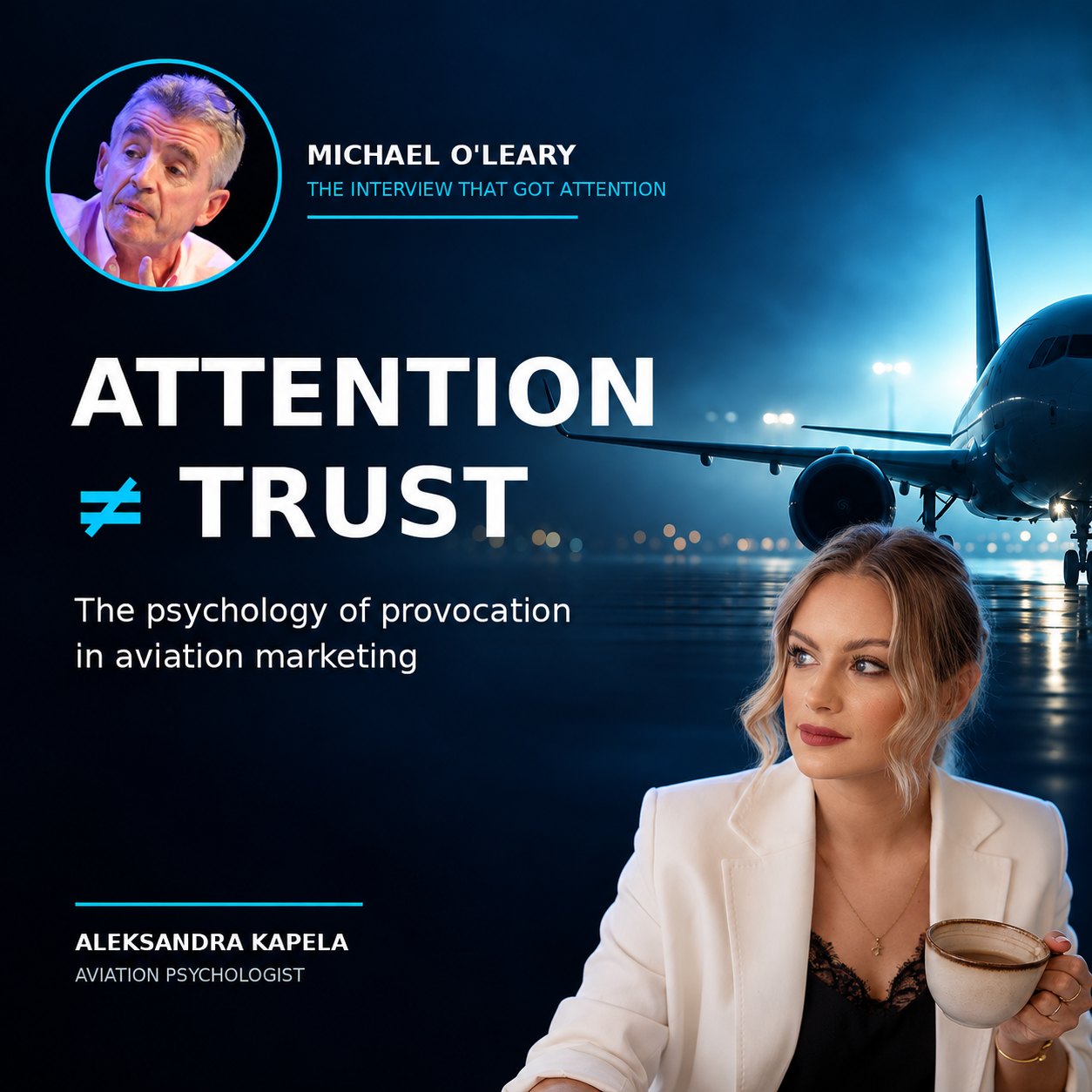
Michael O’Leary got what provocative communication is designed to achieve: attention.
Ahead of Ryanair’s annual general meeting, he referred to competing European airlines as “high-fare rapists.” When reporters challenged whether that language was appropriate, he defended it. The remark travelled quickly across headlines and social media-almost certainly reaching many more people than a conventional message about fares ever would have done. (The Guardian)
From a narrow marketing perspective, the mechanism is easy to understand. The language was unexpected, emotionally charged and socially transgressive. It interrupted attention, generated outrage and encouraged repetition. Every person criticising the phrase also helped distribute it.
But in aviation, the more important question is not simply whether provocation works.
It is: what kind of attention does it create, what does it teach people about the organisation, and what might it cost?
As an aviation psychologist, I see this not only as a marketing controversy, but as a useful case study in organisational psychology, leadership signalling and human factors.
Why provocation captures attention
Human attention is not neutral. We notice what violates expectations, threatens social norms or generates strong emotion. A calm statement about competitive pricing competes with thousands of other messages. An offensive comparison creates an immediate orienting response: people stop, react and remember.
This makes provocation an efficient form of earned media. It turns journalists, critics and audiences into part of the distribution system. The stronger the emotional response, the further the message may travel.
For a brand already built around disruption, bluntness and challenging established competitors, this style may also feel consistent. Some customers may interpret it as evidence of fearlessness or authenticity. Others may see it as calculated theatre.
However, attention, familiarity and trust are different psychological outcomes.
A message can be highly memorable while reducing credibility. It can increase visibility while weakening identification with the brand. It can make the spokesperson more salient while causing the actual value proposition-in this case, lower fares-to disappear behind the controversy.
The strategic question is therefore not, “Did people notice?” They clearly did.
The better question is, “What did they learn?”
A leader’s words are organisational signals
Senior leaders do not communicate only through formal policies, safety statements or annual reports. Their everyday language also teaches employees what the organisation rewards, tolerates and dismisses.
People watch how powerful individuals behave when they are challenged. They notice whether an objection is explored, minimised, mocked or punished. They learn which boundaries are flexible and whose discomfort carries weight.
One public remark cannot tell us what it is actually like to work inside an airline, and it would be irresponsible to infer the quality of Ryanair’s operational safety culture from a media exchange alone. A provocative external brand can coexist with robust internal safety systems; equally, polished corporate language can conceal a workplace in which people are afraid to speak.
But leadership communication is still data. When a concern is raised and the response is to double down, observers form expectations about how disagreement may be received elsewhere.
That matters because employees rarely experience “the brand,” “the leadership culture” and “the safety culture” as perfectly separate systems. They experience one organisation.
Psychological safety is an aviation capability
Psychological safety is often misunderstood as being nice, avoiding disagreement or making everyone comfortable. It is none of those things.
Amy Edmondson’s foundational research describes it as a shared belief that a team is safe for interpersonal risk-taking-safe enough to ask a question, acknowledge uncertainty, admit an error or challenge a decision without expecting humiliation or retaliation. (Harvard Business School)
In aviation, these are not soft behaviours. They are operational capabilities.
Psychological safety is present when:
- a first officer challenges a captain despite a steep authority gradient;
- a cabin crew member reports a concern that may delay departure;
- an engineer stops a task because something does not look right;
- a trainee admits that an instruction was not understood;
- an instructor questions a familiar but unsafe practice;
- an employee can declare fatigue or unfitness without first calculating the likely damage to their career.
The aviation system depends on people making these interpersonal risk calculations correctly. If the perceived social cost of speaking is greater than the perceived safety benefit, important information may remain silent.
This is why Just Culture and psychological safety are closely related, although they are not identical. Just Culture provides the principles and formal protections for fair accountability. Psychological safety influences whether people believe-in the moment-that using those systems is genuinely safe.
Policies can promise non-punitive reporting. What determines behaviour is the employee’s lived prediction of what will happen after the report is submitted.
This is not a theoretical concern. The International Federation of Air Line Pilots’ Associations has emphasised that pilots need to be able to raise safety concerns without fear of punishment, because reporting and open information-sharing are essential to learning before an accident occurs. (Reuters)
The risk is not simply “offence”-it is the lesson about voice
The central human factors issue is not simply that some people found the terminology offensive. Nor is it an argument that corporate leaders must speak in sanitised, emotionless language.
The deeper issue is what happens when a person with less power raises a legitimate concern and watches how it is received.
In safety-critical organisations, employees continuously assess questions such as:
- Will I be taken seriously?
- Will raising this problem make me look weak or difficult?
- Is it safer to remain silent?
- Does this organisation distinguish between constructive challenge and disloyalty?
- Are some concerns considered inconvenient before they are considered valid?
These assessments are shaped by far more than a safety manual. They are influenced by the behaviour of captains, instructors, managers and executives-especially when those people are under pressure or publicly challenged.
The response to challenge often teaches more than the original statement.
Human factors do not begin at the cockpit door
A persistent weakness in the way organisations approach human factors is that they locate the “human” at the sharp end of the system. Pilots and cabin crew are trained in communication, situational awareness, decision-making and threat and error management, while the organisational environment surrounding those behaviours receives less attention.
Yet performance is always contextual.
A crew member may know the correct assertiveness technique and still hesitate if previous challenges were dismissed. An instructor may understand constructive feedback and still avoid difficult conversations if the organisation rewards pass rates over learning. An employee may know the fatigue policy and still report for duty if using that policy is associated with suspicion or career consequences.
Marketing, leadership language, performance targets, rostering, reporting processes and informal norms all become part of the environment in which human performance occurs. They may seem far removed from the flight deck, but they shape the expectations people carry into it.
This systems perspective is central to my book, Human Factors for Pilots and Aviation Specialists: Flight Safety through Modern Approaches to Human Behaviour. Human behaviour cannot be understood as an isolated variable or corrected through another checklist. We have to connect psychological research with the reality of selection, training, leadership and day-to-day operations.
Psychological safety cannot be added as another module
There is a growing tendency to recognise psychological safety as important and then respond by adding a presentation, an e-learning course or a paragraph to a manual.
Education has value. People need a shared language and an introductory understanding of concepts such as speaking up, authority gradients, stress responses and respectful challenge.
But psychological safety is not primarily learned through slides. It is learned through repeated interpersonal consequences.
It must therefore be developed in the environments where operational behaviour actually occurs:
- during simulator scenarios in which a junior crew member must challenge a senior one;
- in debriefings where uncertainty and mistakes are explored without humiliation;
- in line operations where a concern creates inconvenience or delay;
- in promotion and instructor-selection decisions;
- in the way managers respond to fatigue declarations and confidential reports;
- in what happens after someone brings senior leadership bad news.
Changing manuals in aviation is understandably difficult. Procedures interact with regulation, operational constraints, established training systems and multiple stakeholders. Even organisations with intelligent, forward-looking people may struggle to turn a good idea into an approved and workable process.
That is precisely why specialist human factors and organisational psychology input is needed. The objective should not be to insert psychological safety as a separate topic, but to embed the relevant behaviours, decision points and feedback mechanisms into the operational system.
What organisations can examine in practice
Instead of responding to a controversy with another statement about values, aviation organisations can ask more useful questions.
1. How do leaders respond when challenged?
The content of a concern matters, but so does the interpersonal response. Curiosity, clarification and proportionate accountability strengthen voice. Ridicule and reflexive defensiveness suppress it.
2. Do we train people to receive a challenge?
Much of aviation training focuses on giving assertive messages. The other half of the interaction is whether the captain, instructor or manager can receive challenge without becoming defensive or punitive.
3. Are speaking-up behaviours practised under realistic pressure?
Knowing a communication model in a classroom is different from using it when time is limited, hierarchy is salient and operational consequences are real.
4. Do formal protections match employees’ lived experience?
Reporting volume alone is not enough. Organisations should examine the quality of reports, follow-up times, repeat concerns, perceptions of fairness and whether employees believe that raising a problem leads to learning.
5. Are commercial, people and safety messages aligned?
Employees notice contradictions. A company cannot credibly promote respectful challenge in CRM while rewarding dismissive communication elsewhere.
Strong communication does not require careless language
Aviation brands do not need to become bland. Strong opinions, humour and challenge can make communication distinctive. O’Leary’s ability to command attention is undeniable, and his public style has long been part of Ryanair’s disruptive identity.
But using language associated with sexual violence to dramatise high ticket prices is not merely “being direct.” It borrows the gravity of trauma to intensify a commercial message. The attention is gained by imposing part of the emotional cost on people who have nothing to do with the pricing argument.
That may generate coverage. It does not automatically generate trust.
Attention is immediate. Trust is cumulative.
From a marketing perspective, provocation can win the news cycle. From an organisational psychology perspective, it also creates a record of how power is expressed and how challenge is handled.
Every leader communicates twice: once through the explicit message, and once through the behavioural lesson surrounding it.
In aviation, the second message deserves particular attention.
Because a safety culture is not revealed when everyone agrees. It is revealed when someone questions the accepted position, introduces uncomfortable information or says, “I do not think this is right.”
The real test is what happens next.
Attention can be captured in seconds. Trust is built through repeated evidence-and can be weakened by a single signal from the top.
About the Author
Aleksandra Kapela is an aviation psychologist, human factors specialist and the author of Human Factors for Pilots and Aviation Specialists: Flight Safety through Modern Approaches to Human Behaviour.